India–US Trade Agreement: In the Light of the Ideas of Netaji Subhas Chandra Bose and Dr. B. R. Ambedkar
India–US Trade Agreement: In the Light of the Ideas of Netaji Subhas Chandra Bose and Dr. B. R. Ambedkar
Introduction
Today, India–US trade agreements are being promoted with great enthusiasm. Foreign investment, export growth, and economic development are highlighted using attractive terminology. However, behind these glossy claims, an important question arises: Are the interests of Indian farmers, workers, and the poor truly protected?
To understand this clearly, it is essential to examine the issue through the ideas of Netaji Subhas Chandra Bose and Dr. B. R. Ambedkar.
Netaji Subhas Chandra Bose: Political Freedom Is Incomplete Without Economic Independence
Netaji firmly believed that:
“Political freedom becomes meaningful only when a nation is economically self-reliant.”
Netaji did not fight merely against British political rule; he strongly opposed foreign economic exploitation. He clearly understood that even after the end of colonial rule, if the country’s economy fell into the hands of foreign corporations, freedom would remain only symbolic.
In this context, India–US trade agreements raise serious concerns. Competing with American multinational corporations, heavily subsidized agriculture, and advanced technologies is nearly impossible for India’s small and marginal farmers.
If Netaji were alive today, he would ask:
- Does this agreement make India self-reliant or dependent?
- Does it strengthen Indian farmers or push them under corporate control?
If such agreements transfer control over Indian agriculture, seeds, water, markets, and pricing to foreign powers, they directly contradict Netaji’s vision of economic nationalism.
Dr. B. R. Ambedkar: Economic Policies Without Social Justice Are Dangerous
Dr. Ambedkar consistently emphasized social justice and economic equality. He famously stated:
“Political democracy cannot last unless there lies at the base of it social and economic democracy.”
Dr. Ambedkar was fully aware that a free market does not create equal opportunities for all. Those with capital, power, and information always benefit more. Therefore, he strongly supported state intervention to protect the weak.
If India–US trade agreements lead to:
- Weakening of Minimum Support Price (MSP),
- Threats to the Public Distribution System (PDS),
- Complete dependence on market-driven pricing,
then the worst impact will fall on small farmers, landless laborers, and poor consumers. From Ambedkar’s perspective, such outcomes are fundamentally unjust.
Agriculture: Not Just a Trade Commodity, but the Foundation of Life
Both Netaji and Dr. Ambedkar viewed agriculture as more than a commercial activity. For them, agriculture represented:
- Food security
- Rural employment
- Social stability
If agriculture is reduced merely to profit and loss calculations under foreign trade agreements, India’s food security and social harmony will be seriously endangered.
Conclusion: Development for Whom?
The real question today is not whether India should engage in international trade. The real question is:
“Trade for whose benefit, and at whose cost?”
When examined through Netaji Subhas Chandra Bose’s vision of national self-reliance and Dr. B. R. Ambedkar’s principles of social justice, the present form of India–US trade agreements does not appear to favor Indian farmers and the poor.
Unless:
- Farmers’ interests are given top priority,
- MSP, PDS, and local markets are fully protected,
- And farmers’ and workers’ voices are included in policymaking,
such agreements risk harming the fundamental interests of the nation.
Freedom is not limited to flags; it must reach the stomach and dignity of the people.
Author: Arun Ramchandra Pangarkar
Founder:
—
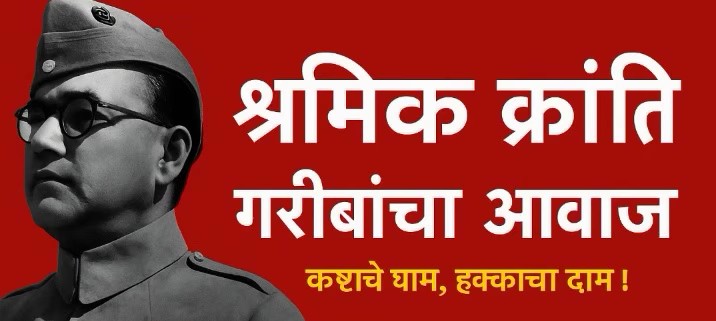
✊ Shramik Kranti – Voice of the Poor

Comments
Post a Comment
✊ आपले विचार खाली नोंदवा. श्रमिकांच्या हक्कासाठी एक विधायक विचारही परिवर्तन घडवू शकतो. सभ्य आणि विचारशील प्रतिक्रिया स्वागतार्ह आहेत.
✊ अपने विचार नीचे दर्ज करें। श्रमिकों के अधिकारों के लिए आपका एक सकारात्मक विचार भी परिवर्तन ला सकता है। शालीन और रचनात्मक टिप्पणियों का स्वागत है।
✊ Share your thoughts below. Even a single constructive idea can bring change for workers’ rights. Respectful and meaningful comments are always welcome.